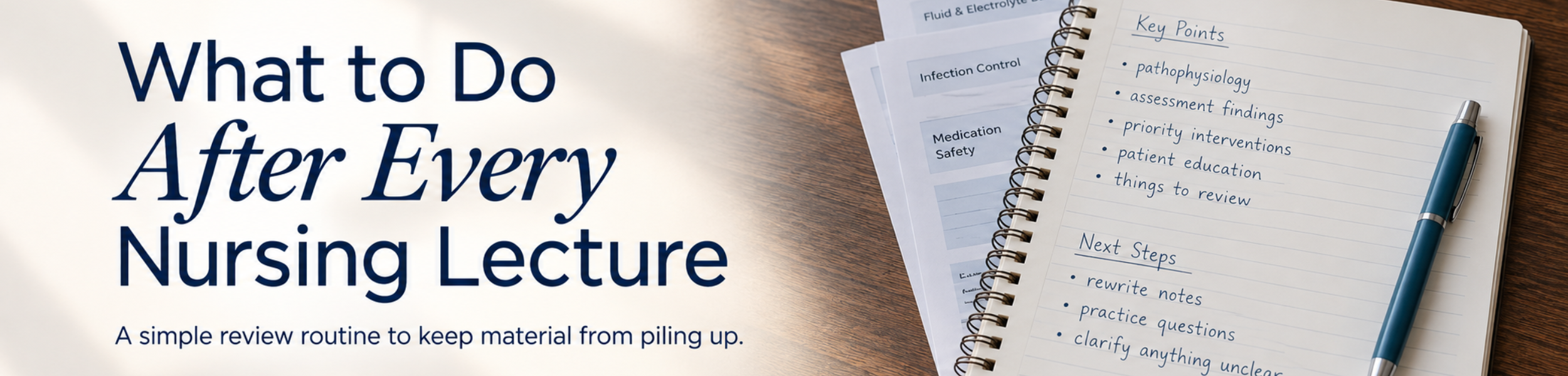
What to Do After Every Nursing Lecture
You do not need to create a perfect study guide after every lecture.
You do need a way to keep today’s material from disappearing into a pile of notes you plan to “go back and look at later.”
That is what the After Class Review Sheet is for.
It is a short check-in you complete after class while the lecture is still fresh. It helps you identify what you learned, notice what you do not understand yet, connect the topic to nursing practice, and make a plan to review it again before exam week.
This is not busywork. It should only take about 15 minutes.
Use It After Class, Not the Night Before the Exam
The best time to complete the sheet is shortly after a lecture, lab, or simulation day.
You do not need to sit down for another two-hour study session. 15 minutes can make a real difference.
For example, if you had a lecture on heart failure from 9:00 a.m. to noon, complete the sheet later that afternoon. . Pull out your notes, open the sheet, and work through the sections while you still remember what your instructor emphasized.
The goal is not to memorize the entire lecture that day. The goal is to make sure you know:
What the most important points were
What you still need to clarify
What this topic means for patient care
When you will review it again
Start With the Course, Date, and Topic
At the top of the sheet, write the course, date, and lecture topic or chapter.
For example:
Course: Adult Health II
Date: September 14
Topic/Chapter: Heart Failure and Dysrhythmias, Chapter 31
This may seem basic, but it matters when you are reviewing several weeks later. You want to be able to look back and immediately know where that page fits in your course.
Write Three Things You Learned Today
The first section asks: What did I learn today?
This is not the place to copy three random facts from your slides. Try to write three takeaways in your own words. If you cannot explain it in a simple sentence, that is useful information. It may be a topic you need to revisit.
After a heart-failure lecture, your takeaways might look like this:
A sudden increase in shortness of breath, crackles, edema, and weight gain can point to worsening fluid overload.
Daily weights are one of the best ways to monitor changes in fluid status.
The nurse needs to connect assessment findings with whether the patient is getting better, worse, or needs intervention.
Those are not meant to replace your notes. They are the big ideas you want to keep connected as you continue studying.
Write Down What Still Does Not Make Sense
Next, ask yourself: What do I still need to clarify?
This is one of the most useful parts of the sheet because it keeps you from pretending you understand something just because you heard it once.
Maybe you understand the overall disease process but still feel unsure about:
Why certain medications are used
Which findings are expected versus concerning
When a symptom becomes urgent
How two similar conditions are different
What you would actually assess or do first as the nurse
Write it down. For example: I still need to understand how to tell whether a patient’s symptoms are related to left-sided versus right-sided heart failure.
Now you have a specific question to bring to your notes, instructor, classmate, textbook, or next study session.
You are no longer just writing “review heart failure” on your to-do list. You know exactly what you need to review.
Connect the Topic to Nursing Practice
The third section asks: What would this topic change about what you assess, recognize, teach, or do for a patient? This is where nursing school content starts to become more than information to memorize.
Ask yourself:
What would I assess?
What findings would concern me?
What would I monitor over time?
What might I need to teach the patient?
What could change the plan of care?
Using the same heart-failure example, you might write:
For a patient with heart failure, I would pay attention to respiratory status, oxygen saturation, lung sounds, edema, daily weight, urine output, and whether symptoms are improving or worsening. You are practicing how to connect lecture content to a patient, not just how to repeat it on an exam.
Choose One Next Step
The last section is the part that keeps the sheet from becoming one more page you complete and forget about. Choose one small next step for your review within the next 48 hours. You might choose to:
Review your notes
Make flashcards
Complete practice questions
Make a comparison chart
Then write down exactly when you will do it. Instead of saying: I need to study heart failure.
Write: Tuesday at 7:00 p.m.: Complete 10 heart-failure and dysrhythmia practice questions. Review every rationale.
Or: Wednesday at 4:30 p.m.: Make a comparison chart for left-sided and right-sided heart failure.
The more specific the plan, the more likely you are to follow through.
Add It to Your Actual Schedule
Do not leave the sheet on your desk or in a file 4 folders deep on your tablet and assume you will remember your next step later. Add the review session to your calendar or planner before you move on.
This is especially important in nursing school because the next assignment in Canvas is not always the only thing you need to be thinking about. You may have an online module due tomorrow, but you may also have a pharmacology exam, clinical paperwork, and a major lecture topic that will be tested next week.
The sheet helps you look beyond the next deadline and build review into your week before you are overwhelmed.
What This Might Look Like Across One Week
Imagine you complete one After Class Review Sheet after each major lecture that week.
By the weekend, you will have a clear record of:
The key concepts you covered
The questions you still need answered
The areas you missed on practice questions
The topics that need more attention before the exam
Instead of opening your notes the night before the test and wondering where to start, you already have a list of your weak areas and a record of what needs review.
That is a much better place to begin.
Keep It Simple
You do not have to use the sheet perfectly after every single class.
Start with the lectures or topics that feel the most content-heavy, confusing, or important for an upcoming exam. Use it after a pharmacology lecture, a difficult med-surg topic, a simulation, or any class where you leave thinking, “I need to make sure I understand that.”
The purpose is not to give yourself more work.
The purpose is to make the study time you are already putting in more focused and useful.
Download the After Class Review Sheet, use it after your next lecture, and give yourself a clear next step before the material starts piling up.