The Question Has 4 Correct Answers. Now What?
You read the question, look through the answer choices, and immediately hit a problem:
They all sound right.
You would assess the patient. You would notify the provider. You would implement the appropriate intervention. And yes, you would continue monitoring afterward. So how are you supposed to choose just one?
The key is recognizing that the question usually isn't asking you which actions are appropriate. Several of them may be. It's asking you to decide which action takes priority over the others. Which one needs to happen first? Which one addresses the most immediate concern? Which one can't safely wait while you do something else?
That's why these questions can be difficult even when you know exactly how to care for the patient. The challenge isn't always knowing what to do. Sometimes it's knowing what to do first.
Sometimes the Wrong Answers Aren't Really Wrong
In a basic knowledge question, you may be able to eliminate answers because they're clearly incorrect. Clinical application questions are different.
You might get four options that all sound like reasonable nursing care:
Reassess the patient's vital signs.
Notify the healthcare provider.
Administer a prescribed intervention.
Document the patient's response.
None of those actions is inherently wrong. But that doesn't make them equally important at this moment for this patient. That's where clinical judgment comes in.
Instead of asking: Which answer is correct? Start asking: Which correct answer best responds to the problem the question gave me?
First: Figure Out What the Question Is Making You Decide
Before comparing the answer choices, look at the actual question. What decision are you being asked to make? There is a big difference between:
What should the nurse assess?
Which finding requires immediate follow-up?
What should the nurse do first?
Which intervention is most appropriate?
Which patient should the nurse see first?
Which finding should the nurse report?
Those questions may use the exact same patient information and still have different answers. If the question asks what you should assess, choose the assessment that gives you the information you need. If it asks what requires immediate intervention, you're looking for the problem that cannot safely wait. If it asks what you should report, you're deciding which information requires escalation.
Don't choose an answer simply because it's a good nursing action. Choose the answer that actually answers the question being asked.
Don't Ask Whether the Answer Is Correct. Compare It to the Other Choices.
This is where these questions get tricky. You read an answer choice like: Notify the provider of the patient's change in condition.
And immediately think: Yes. I would absolutely do that.
And you may be right. But that doesn't automatically make it the best answer.
When several answer choices are appropriate, you can't evaluate each one by asking whether you would do it. You have to compare the choices to each other.
Maybe you would notify the provider. But first you need to stop an unsafe medication.
Maybe you would reassess the patient. But first you need to prevent an immediate fall.
Maybe you would document the finding. But only after you've addressed the patient's respiratory distress.
So when an answer sounds correct, don't stop at: Would I do this?
Take it one step further: Would I do this before the other three choices?
Sometimes the difference between two correct answers isn't whether you would do them. It's when you would do them.
Find the Answer That Changes the Patient's Immediate Outcome
When several options are appropriate, look for the action that most directly addresses the patient's current problem or immediate risk.
Consider this patient:
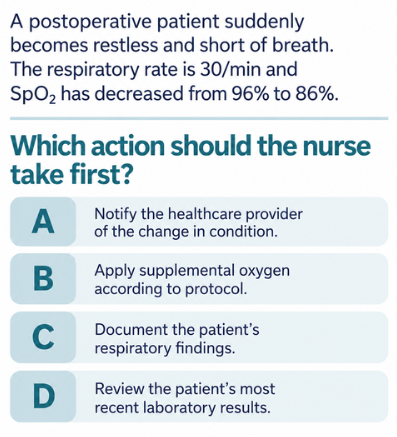
Could all four eventually happen? Absolutely. But they don't have the same priority.
The patient is hypoxemic now. Reviewing labs may provide useful information. Documentation is necessary. The provider may need to be notified. But none of those actions immediately addresses the patient's oxygenation.
The best answer is B: Apply supplemental oxygen according to protocol.
The other answers didn't become wrong. They became later. And that distinction matters.
Ask: What Happens If I Delay This?
When you're stuck between two answers that both seem appropriate, think about what would happen if you didn't do each one right away.
For example: A patient receiving a blood transfusion suddenly develops chills, dyspnea, and back pain.
The nurse may need to:
Stop the transfusion.
Assess the patient's vital signs.
Notify the provider.
Document what happened.
All four actions are appropriate. The question is which one cannot safely wait?
If you delay documentation for a few minutes, does it place the patient in immediate danger? No.
If you delay notifying the provider long enough to stop the transfusion, are you putting the patient at greater risk? No.
But what happens if you assess, call the provider, or begin documenting while the blood is still infusing? The patient continues to receive the substance that may be causing the reaction.
That's the difference. Stop the transfusion first.
When you're deciding between multiple correct answers, consider the consequence of delaying each one. The action that prevents the greatest immediate harm often needs to happen first.
Don't Automatically Choose “Assess First”
Nursing students hear this rule all the time: Assess before you intervene.
And often, that's exactly what you should do. If you don't have enough information to understand the problem or choose a safe intervention, you need to assess first.
But sometimes the question has already given you the information you need to act.
For example: A patient is standing beside the bed when they suddenly become pale and say, “I feel like I'm going to pass out.”
You could check the patient's blood pressure. You could ask additional questions. You could perform a more focused assessment. But none of those findings would change what you need to do right now.
The patient is at immediate risk for falling. Help the patient into a safe position first. Then assess further.
Before automatically choosing an assessment answer, ask yourself: Do I need this additional information before I can safely act? If the answer is yes, assessment may need to come first.
If the question has already identified an immediate threat and you know what needs to be done to protect the patient, delaying that action for more assessment may not be the best choice.
Assess first when you need more information, not simply because “assess” appears in an answer choice.
Watch Out for Answers That Are Correct, but Not Yet
Sometimes an answer is completely appropriate for the patient, but it belongs later in the sequence of care.
For example: A patient receives a PRN pain medication for severe postoperative pain.
Appropriate nursing actions might include:
Administer the prescribed pain medication.
Reassess the patient's pain after the medication has had time to take effect.
Document the patient's response to the medication.
Notify the provider if the pain remains severe despite treatment.
All of these may be appropriate. But they don't happen at the same time. You can't evaluate the patient's response before the medication has had time to work. You wouldn't notify the provider that the intervention was ineffective before determining whether it worked. And you can't accurately document the patient's response before you've reassessed it.
The actions make sense, but only in the right sequence. So when you're deciding between several correct answers, ask: Has something else in the patient's care need to happen before I can do this? Sometimes an answer isn't wrong. It's just not time for it yet.
A Simple Way to Rank Four “Correct” Answers
When several answer choices seem appropriate, don't try to decide which one is the most “nursing” answer.
Instead, narrow them down by asking:
What is the question actually asking me to decide?
Are you choosing what to assess, what to do first, what to report, or what requires immediate attention?
What does this patient need right now?
Focus on the problem the patient is experiencing in the scenario—not everything that may eventually need to happen.
Which action cannot safely wait?
Consider what could happen to the patient if you choose another action first.
Do I need more information before I act?
If you don't have enough information to make a safe decision, assess. If the immediate problem is already clear, don't delay a necessary intervention just to gather more data.
Does something else need to happen before this answer makes sense?
Reassessment, documentation, teaching, and evaluation may all be appropriate—but they may belong later in the sequence.
The goal isn't to find the one answer that is “correct” while everything else is wrong.
The goal is to determine which correct action belongs first for this patient, in this situation, at this moment.
When You're Down to Two Answers
Sometimes you've eliminated two choices, but the last two both seem completely reasonable. At this point, don't keep rereading them and asking: Which one sounds more correct?
Instead, force yourself to explain why each one should happen first. Try completing this sentence for both answers:
I would choose ______ first because ______. If I delay this action, ______.
For example, imagine a patient is short of breath with an SpO₂ of 86%, and you're deciding between applying supplemental oxygen or notifying the provider. Now justify each one.
Apply oxygen: The patient is currently hypoxemic. Oxygen directly addresses the immediate problem, and delaying intervention could allow the hypoxemia to worsen.
Notify the provider: The provider needs to know about the change in the patient's condition, but making the call does not immediately improve the patient's oxygenation.
Both actions are appropriate. But once you explain why each one should happen first, the difference becomes easier to see. One addresses the immediate problem. The other still needs to happen, but it can happen after the immediate problem is addressed.
When you're stuck between two good answers, don't just compare the wording. Compare what each answer actually does for the patient right now.
At Clinical Judgment Lab, the goal isn't just to help you learn more nursing content. It's to help you get better at making decisions with the content you already know.
Because knowing that four actions are appropriate is only part of the work. You also need to recognize which one matters most, which one needs to happen first, and which ones can safely wait.
Explore study guides, clinical thinking tools, quick-reference resources, and nursing study materials designed to help you move beyond memorizing information and practice using it in patient situations.
Knowing what to do matters. Knowing what to do first is clinical judgment.
→ Visit the Clinical Judgment Lab Etsy Shop