

Assessment
Practice recognizing important findings, distinguishing expected from unexpected, and deciding when you need more information versus when it's time to act.
-
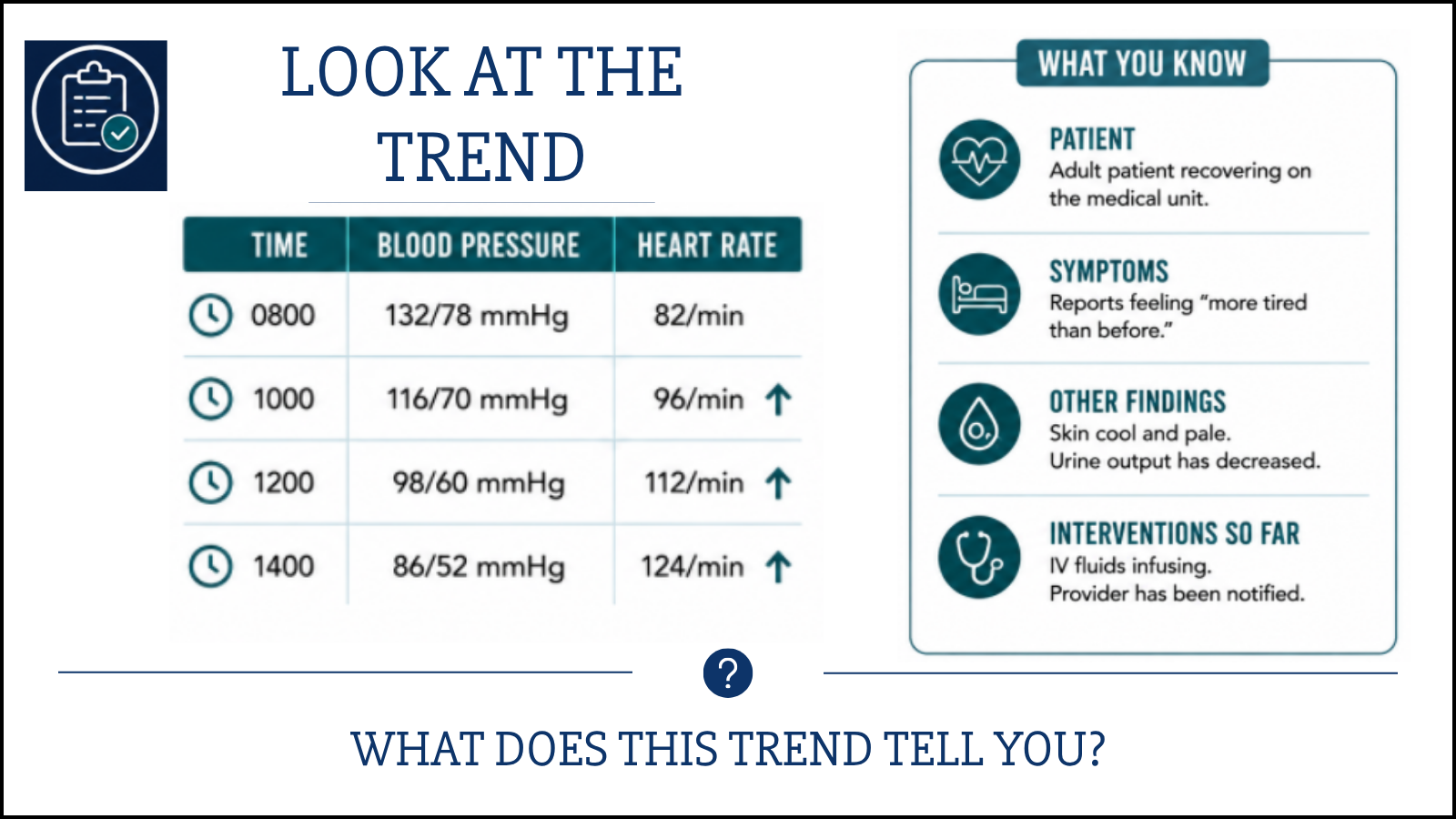
What the Trend Tells You:
The patient is showing signs of worsening perfusion and clinical deterioration.Why this matters:
One blood pressure reading might not tell you the whole story. Here, the pattern is what matters.The blood pressure has progressively fallen from 132/78 to 86/52 mmHg, while the heart rate has steadily increased from 82 to 124/min. The patient is also becoming more fatigued, with cool, pale skin and decreasing urine output.
These findings fit together. The rising heart rate may represent the body's attempt to compensate as blood pressure and tissue perfusion decline. Cool, pale skin and decreased urine output provide additional evidence that organs may not be receiving adequate blood flow.
The fact that the trend continues despite IV fluids makes the deterioration even more concerning and requires prompt reassessment and escalation of care.
Don't get distracted by:
Looking at the final blood pressure as an isolated value. The most important information is the direction the patient is moving and the other findings that support that change.CLINICAL JUDGMENT TAKEAWAY
A trend can tell you more than a single abnormal value. Ask whether the patient's findings are improving, staying stable, or moving in the wrong direction and connect the trend to the rest of the clinical picture.
-
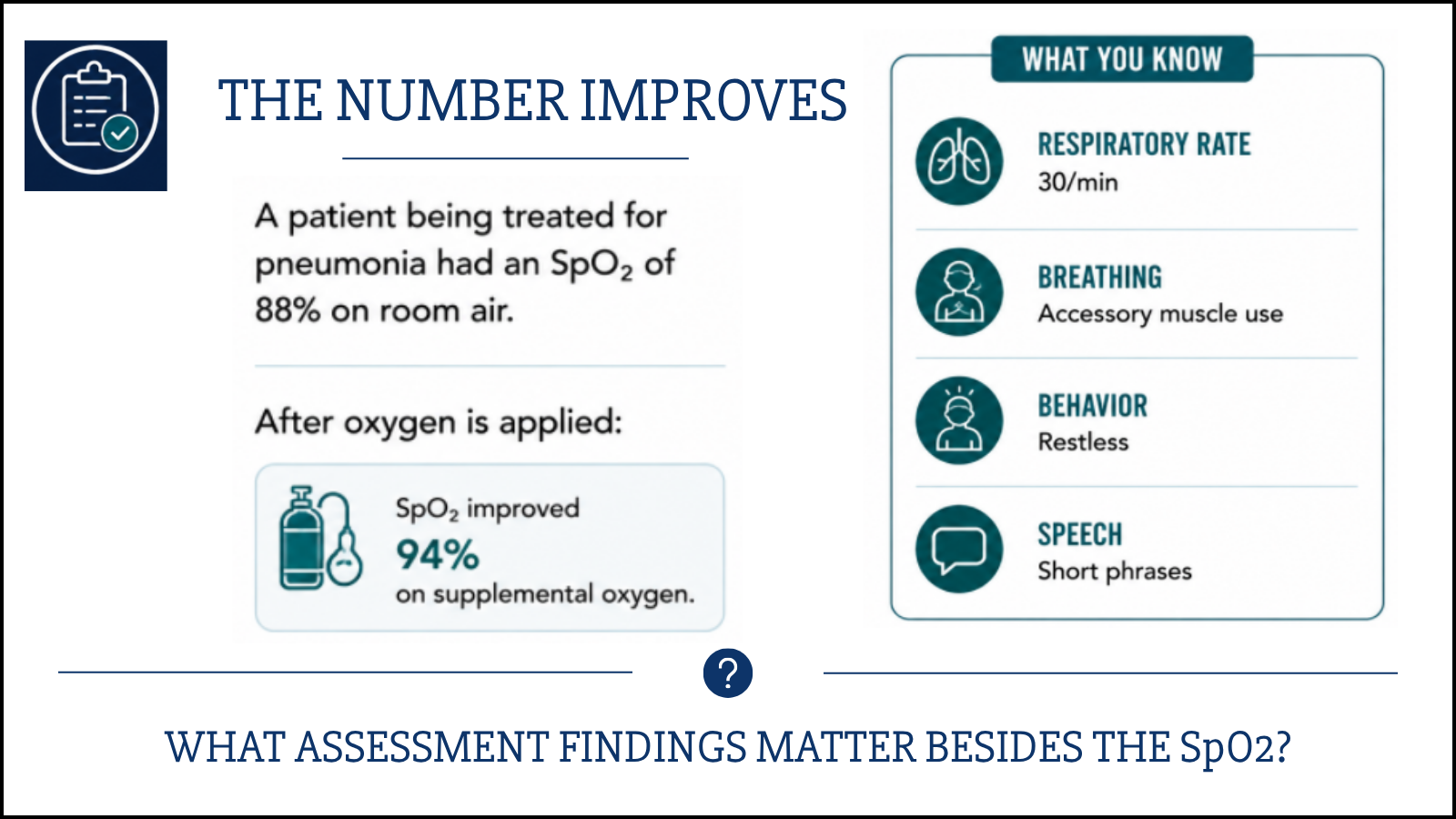
Is the Patient Improving?
The oxygen saturation has improved, but the patient is still showing signs of respiratory distress.Why this matters:
An SpO₂ of 94% may look reassuring, but it is only one piece of the assessment. The patient remains tachypneic at 30 breaths/min, is using accessory muscles, is restless, and can speak only in short phrases.Those findings suggest the patient is still working hard to breathe despite the improved oxygen saturation. Supplemental oxygen may have improved the number on the monitor without resolving the underlying respiratory problem.
The nurse should continue a focused respiratory assessment, evaluate the patient's response to treatment, and escalate care if the respiratory distress persists or worsens.
Don't get distracted by:
A single improved value. A better SpO₂ does not automatically mean the patient is better.CLINICAL JUDGMENT TAKEAWAY
Evaluate the patient, not just the monitor. Improvement in one number should match improvement in the patient's overall clinical picture.
-
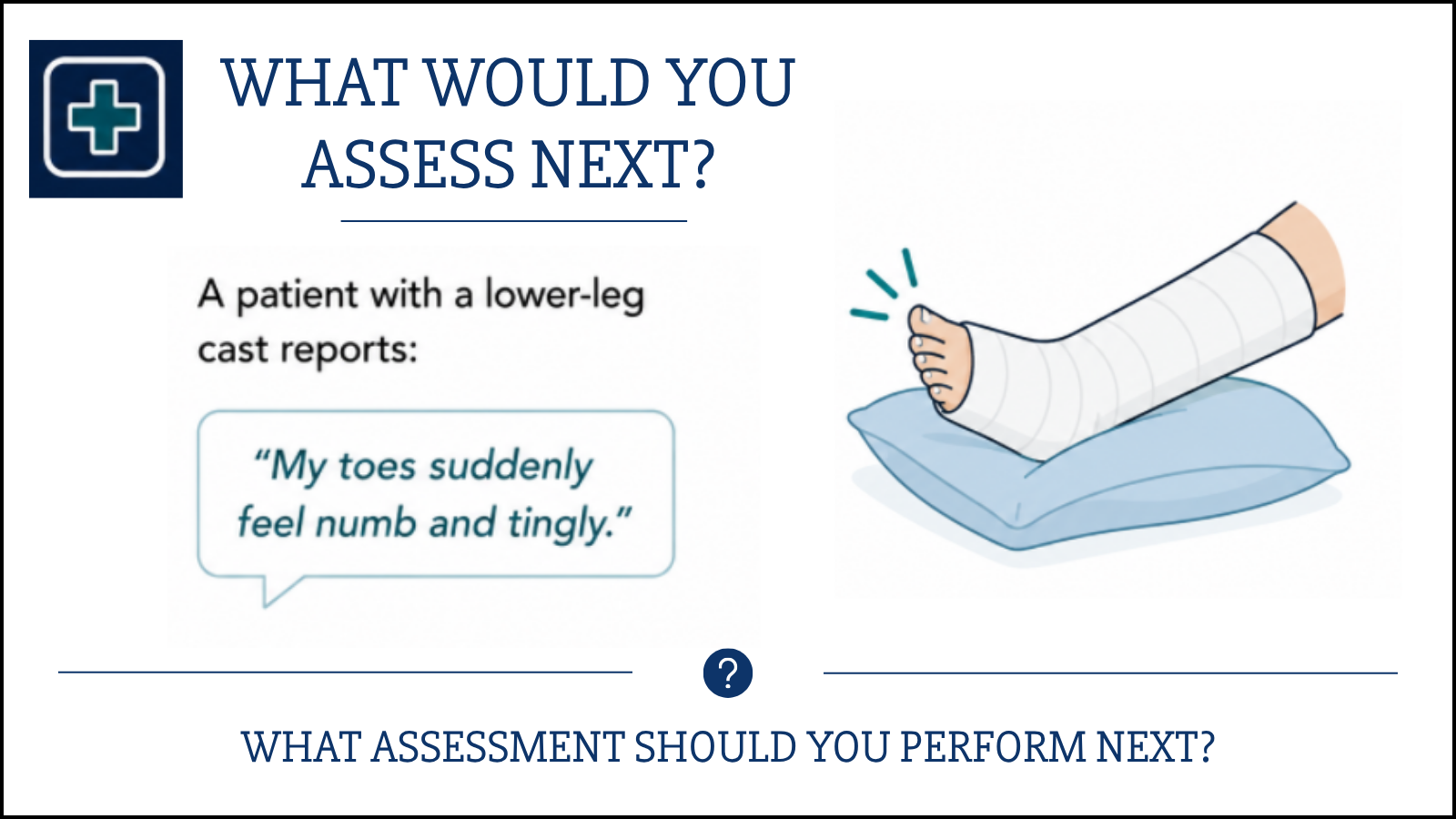
What Should You Assess Next?
Perform a focused neurovascular assessment of the affected extremity.Why this matters:
New numbness and tingling in the toes can indicate a change in nerve function orcirculation below the cast. The nurse needs more information to determine whether the extremity is being adequately perfused and whether increasing swelling or pressure may be causing neurovascular compromise.Assess and compare both extremities for:
Sensation — numbness, tingling, or decreased sensation
Movement — ability to move the toes
Color and temperature — pallor, cyanosis, or coolness
Capillary refill
Peripheral pulse, when accessible
Pain — especially increasing pain or pain that seems out of proportion to the injury
The nurse should also assess the cast and extremity for increasing swelling, tightness, or other changes.
Don't get distracted by:
Assuming numbness and tingling are expected simply because the patient has a cast. A new change in sensation requires further assessment.CLINICAL JUDGMENT TAKEAWAY
When a patient reports a new symptom, use a focused assessment to investigate what changed. Don't just document the complaint. collect the information needed to determine what it could mean.

-
What Do You Need to Know Next?
You need more information to determine why the urine output has decreased and whether the patient is showing signs of a larger problem.Why this matters:
A urine output of 20 mL/hr for 2 hours is concerning, but the number alone does not tell you the cause. Before jumping to a conclusion, assess the patient and look for information that helps explain the change.The nurse should assess:
Vital signs and trends — especially blood pressure and heart rate
Overall perfusion — skin color and temperature, mental status, capillary refill, and other signs of decreased circulation
Fluid status — intake and output, mucous membranes, edema, and other indicators of fluid balance
Urinary catheter and tubing — check for kinks, obstruction, dependent loops, or other problems affecting drainage
Bladder — assess for distention or evidence that urine is being retained rather than drained
Relevant laboratory results — including renal function and other available data that may help explain the change
The nurse should also consider the patient's postoperative course, fluid losses, medications, and whether the urine output has continued to trend downward.
Don't get distracted by:
Assuming the kidneys are the problem simply because the finding involves urine. Decreased urine output can have several causes, including reduced circulating volume, impaired perfusion, urinary retention, or a problem with the catheter itself.CLINICAL JUDGMENT TAKEAWAY
An abnormal finding tells you something needs attention, it doesn't always tell you why. Use a focused assessment to investigate the finding before deciding what it means.
-
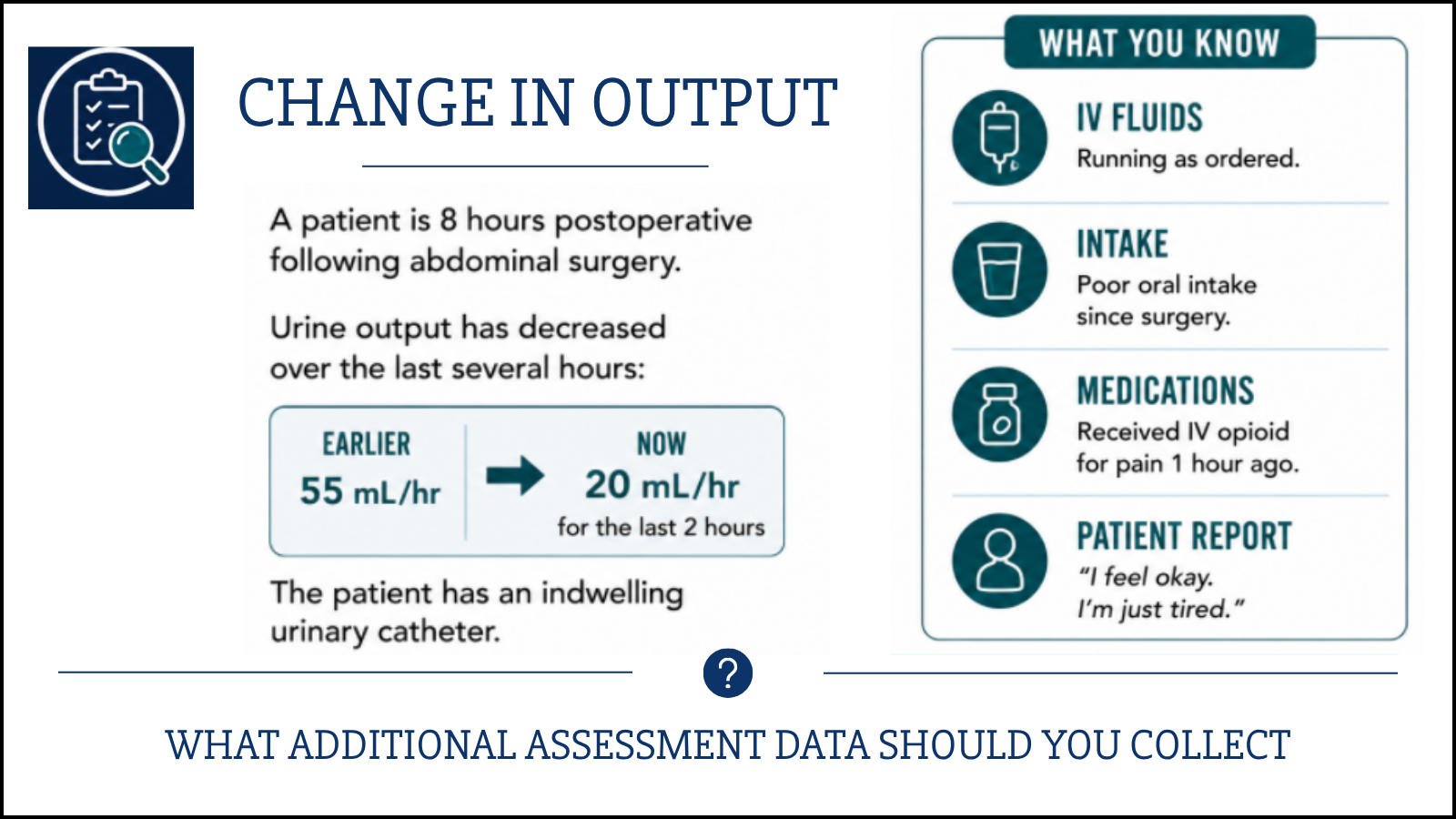
What Do You Need to Know Next?
You need more information to determine why the urine output has decreased and whether the patient is showing signs of a larger problem.Why this matters:
A urine output of 20 mL/hr for 2 hours is concerning, but the number alone does not tell you the cause. Before jumping to a conclusion, assess the patient and look for information that helps explain the change.The nurse should assess:
Vital signs and trends — especially blood pressure and heart rate
Overall perfusion — skin color and temperature, mental status, capillary refill, and other signs of decreased circulation
Fluid status — intake and output, mucous membranes, edema, and other indicators of fluid balance
Urinary catheter and tubing — check for kinks, obstruction, dependent loops, or other problems affecting drainage
Bladder — assess for distention or evidence that urine is being retained rather than drained
Relevant laboratory results — including renal function and other available data that may help explain the change
The nurse should also consider the patient's postoperative course, fluid losses, medications, and whether the urine output has continued to trend downward.
Don't get distracted by:
Assuming the kidneys are the problem simply because the finding involves urine. Decreased urine output can have several causes, including reduced circulating volume, impaired perfusion, urinary retention, or a problem with the catheter itself.CLINICAL JUDGMENT TAKEAWAY
An abnormal finding tells you something needs attention, it doesn't always tell you why. Use a focused assessment to investigate the finding before deciding what it means.
-
Most Concerning Finding:
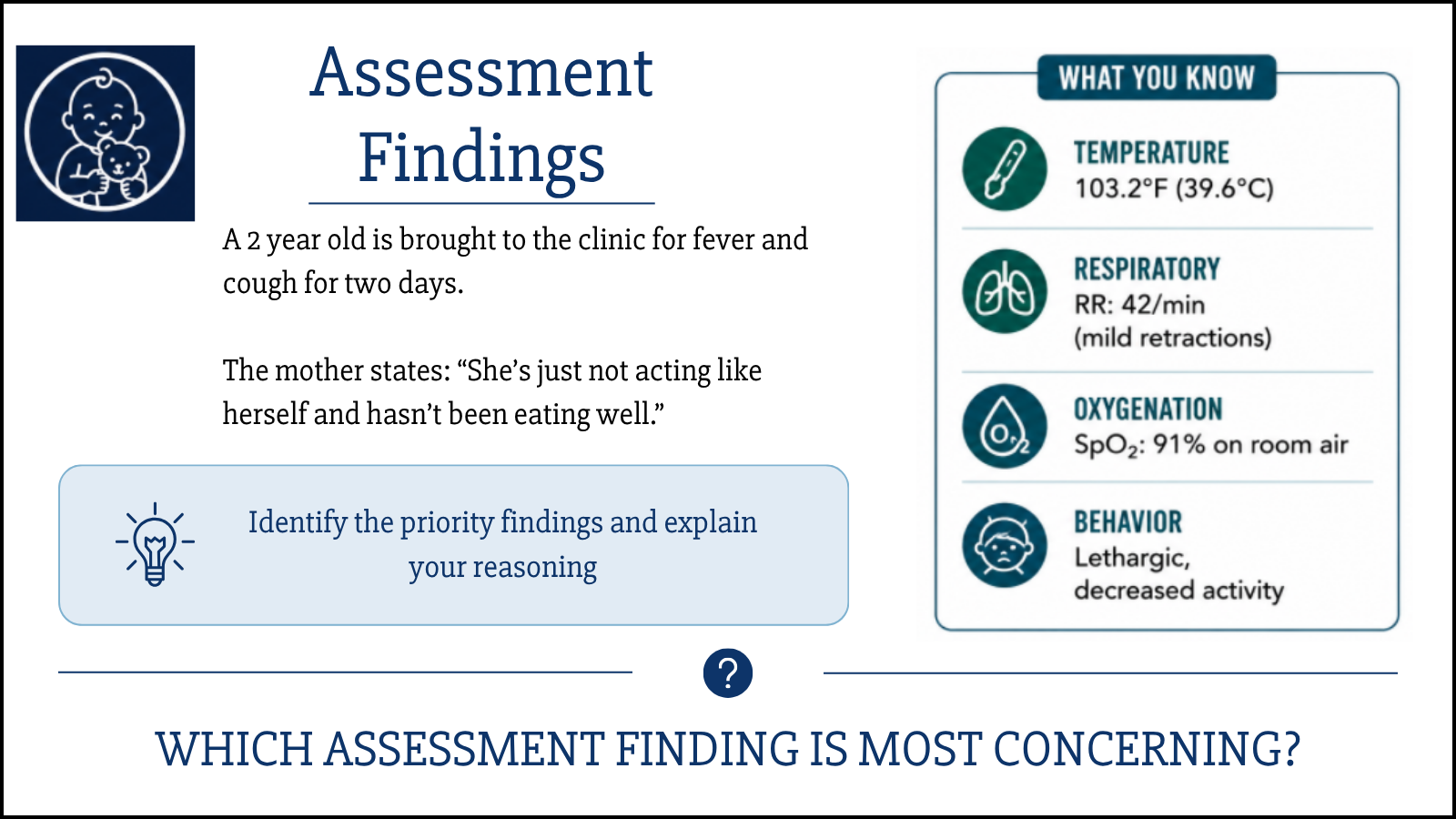
SpO₂ of 91% on room air, especially when considered with the child's increased work of breathing.Why this matters:
The child has several abnormal findings, but they do not all carry the same immediate risk. An oxygen saturation of 91%, respiratory rate of 42/min, and retractions indicate that the child is having difficulty maintaining adequate oxygenation.The lethargy is also concerning because a change in activity or responsiveness can signal that the child is becoming more ill. When considered together with the respiratory findings, it adds to the concern rather than standing alone.
The fever of 103.2°F is important and needs treatment and further evaluation, but the immediate threat is impaired oxygenation and respiratory compromise.
Don't get distracted by:
The highest number on the page. A temperature of 103.2°F may grab your attention, but priority is determined by the potential threat to the patient, not simply which value looks most abnormal.CLINICAL JUDGMENT TAKEAWAY
Don't evaluate findings in isolation. Connect the cues and ask which pattern represents the greatest immediate threat to the patient.