You Knew the Answer. So Why Did You Miss It?
You finish a nursing exam, look at a question you missed, read the rationale, and immediately think: “I knew that.”
And you probably did.
You knew the disease process. You knew the medication. You knew the lab value. You knew the signs and symptoms. If someone had asked you about the concept before the exam, you probably could have explained it.
So why didn't that knowledge get you to the right answer?
Because nursing questions aren't always testing whether you know the information. They're testing whether you can use the information to make a decision.
That means you may need to recognize which finding matters, connect several pieces of patient data, decide what is most concerning, or determine what the nurse should do first.
That's why reviewing a missed question can be so frustrating. You didn't necessarily miss it because you didn't study enough. You just didn't recognize what the question wanted you to do with what you knew.
Knowing the Content Is Only Part of the Question
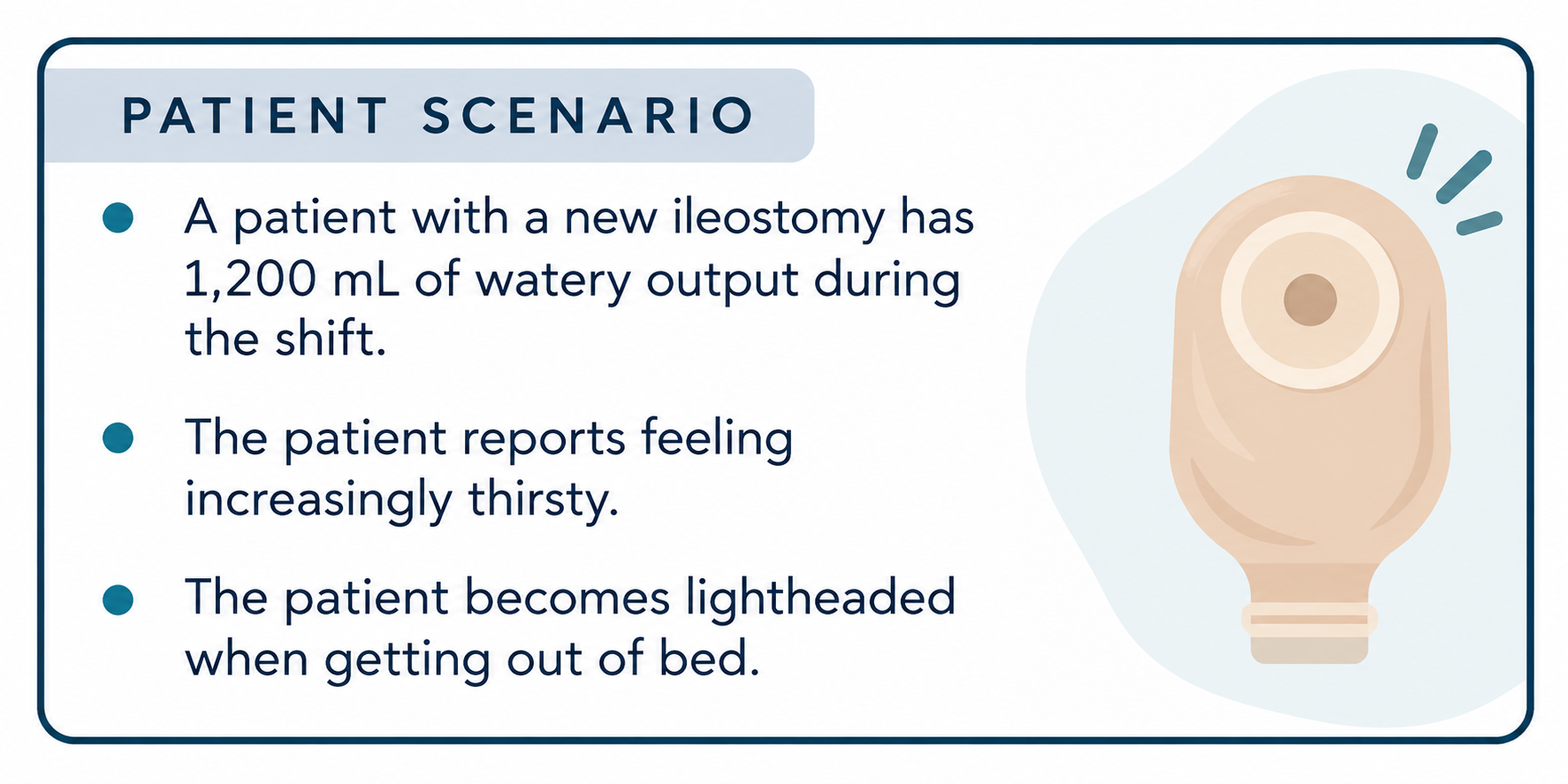
Consider this situation: A patient with a new ileostomy has 1,200 mL of watery output during the shift. The patient reports feeling increasingly thirsty and becomes lightheaded when getting out of bed.
There may not be a single fact in this scenario that you haven't learned before.
You know ileostomy output is generally liquid. You know an ileostomy can result in significant fluid and electrolyte losses. You know thirst and lightheadedness can be signs of fluid volume loss.
But nursing questions rarely stop at asking whether you know those facts individually.
You have to put them together.
The important clue isn't simply that the ileostomy output is watery. It's the amount of output combined with the patient's symptoms. Together, those findings should change how you interpret the situation.
That's why a question can feel obvious when you review it afterward. You may have known every piece of information in the question. The difficult part was recognizing what those pieces meant together.
Abnormal Doesn't Always Mean Priority
Nursing questions often give you more than one finding that catches your attention.
Imagine a patient has:
Temperature: 100.2°F (37.9°C)
Blood glucose: 168 mg/dL
Blood pressure: 86/50 mm Hg
All three values may get your attention.
Now add:
Increasing lethargy
Cool extremities
Urine output of 15 mL in the last hour
The blood pressure of 86/50 mm Hg now carries more weight. Not simply because it falls outside the expected range, but because it fits with other findings suggesting poor perfusion.
This is where nursing questions move beyond identifying abnormal values.
Instead of asking: Which number is abnormal?
You have to ask: Which finding, when I consider the rest of the patient information, tells me something important may be happening?
An abnormal value doesn't exist by itself. Its significance depends on the patient, the other findings, and what those findings suggest when you look at them together.
A Reasonable Nursing Action May Still Be the Wrong Answer
This is one of the most frustrating parts of nursing questions. Sometimes you choose an answer and later discover that it wasn't necessarily wrong. It just wasn't the best answer to the question that was asked.
Consider the scenario:
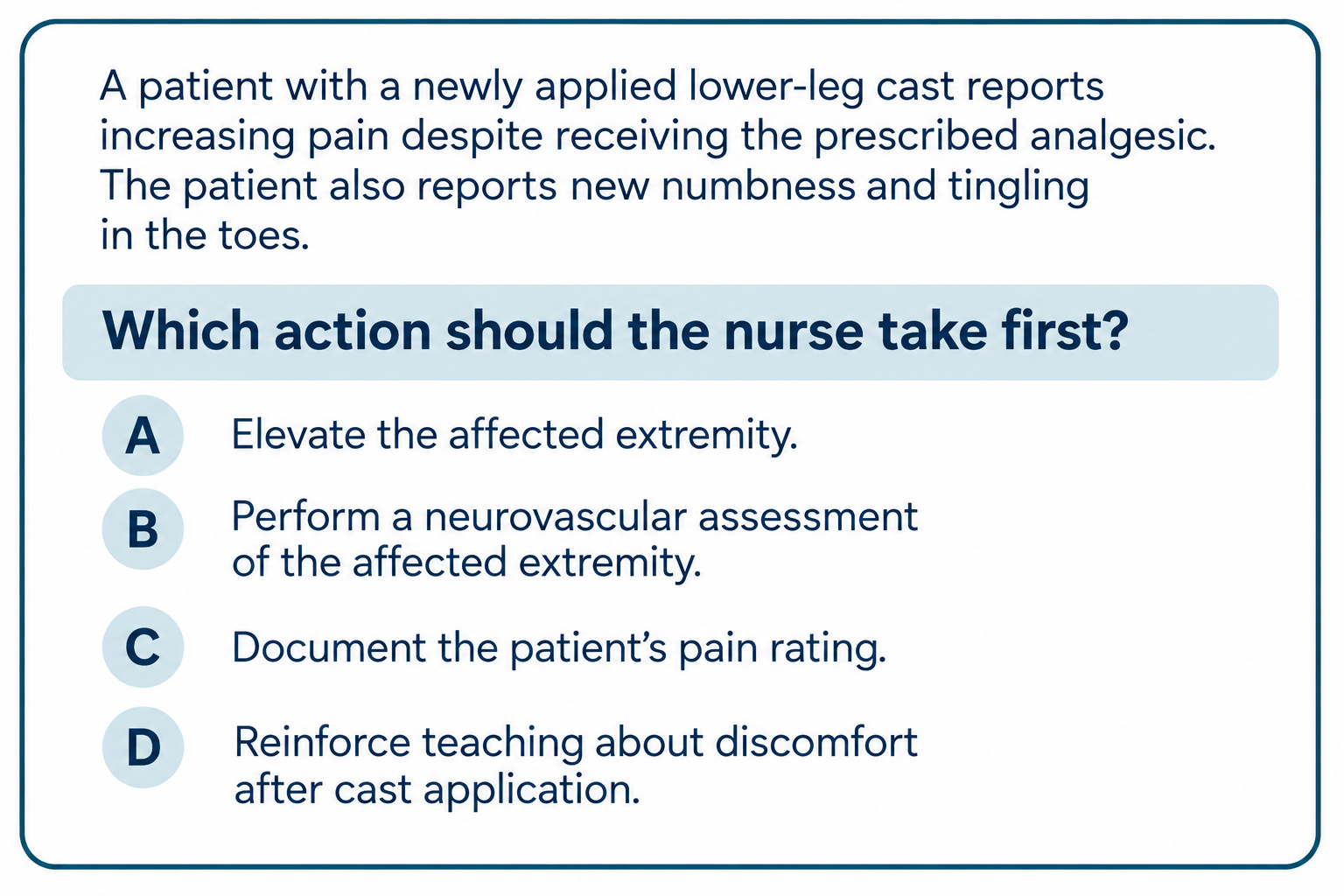
Elevation may be part of caring for a patient with a cast. Pain should be documented. Patient teaching matters.
But those facts don't make those choices equally appropriate right now.
Look at what changed: the patient's pain is increasing despite medication, and numbness and tingling have developed.
Those cues raise concern about neurovascular compromise. Before choosing an answer, the more useful question becomes:
What does this patient need based on what is happening right now?
In this situation, a neurovascular assessment directly evaluates the problem suggested by the patient's findings.
This is an important distinction on nursing exams. Don't evaluate an answer only by asking whether it is a correct nursing action.
Ask whether it is the right action for this patient, at this point in the situation.
Priority Rules Are Tools, Not Shortcuts
Nursing school gives you a lot of priority rules:
ABCs.
Acute before chronic.
Unstable before stable.
Assess before you intervene.
Maslow.
These frameworks are useful because they help organize your thinking. Problems happen when the rule becomes the entire decision.
Imagine you need to decide which patient to see first:
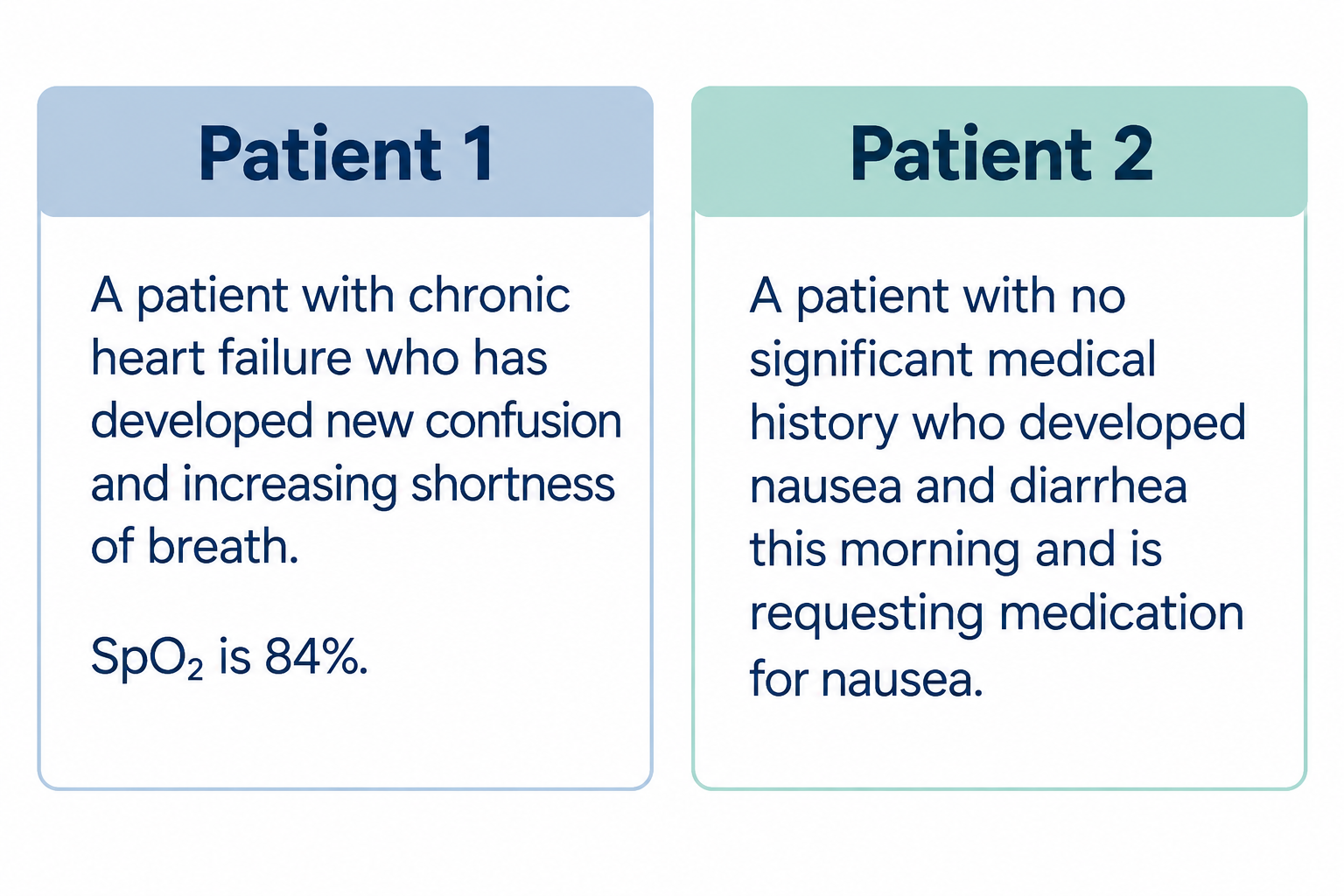
If you focus only on acute before chronic, Patient 2 might catch your attention because the illness began this morning.
But you're not deciding which diagnosis is more acute.
You're deciding which patient needs you first.
The patient with heart failure has a chronic diagnosis, but the current findings are new and concerning. Increasing shortness of breath, confusion, and an SpO₂ of 84% suggest an immediate problem.
Use priority frameworks to help interpret the situation, not to avoid interpreting it.
Before applying a rule, ask: What is actually happening with each patient right now?
Don't Build a Different Patient in Your Head
Sometimes nursing knowledge creates another problem: you can think of too many possibilities.
Imagine the question tells you: A patient who had abdominal surgery yesterday reports increasing incisional pain.
Your brain might immediately start filling in the gaps:
Maybe the patient just walked with physical therapy.
Maybe the pain medication is wearing off.
Maybe the patient coughed and irritated the incision.
Maybe this is expected postoperative pain.
Every one of those explanations is possible.
But the question didn't give you any of them.
Once you start adding your own details, you're no longer answering the scenario in front of you. You're answering a slightly different scenario that you created.
Watch for thoughts that begin with:
Maybe...
What if...
They probably...
Usually...
When that happens, return to the information you were actually given.
Figure Out the Problem Before You Look for the Answer
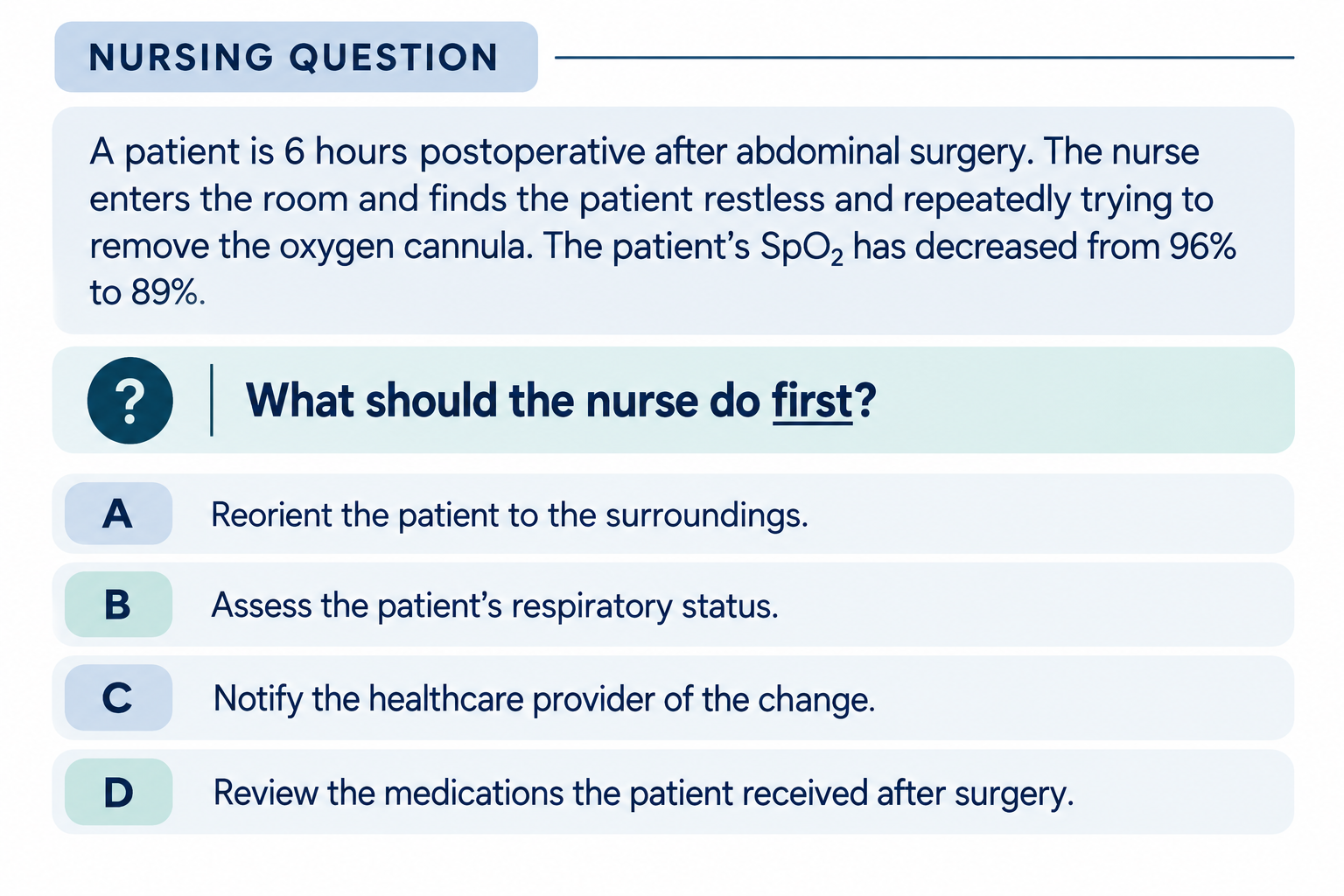
If you go straight to the answer choices, it's easy to start debating them:
The patient is confused, so maybe A.
Assessment usually comes first, so maybe B.
The oxygen saturation dropped, so maybe I should notify the provider.
Could medication be causing this? Maybe D.
Instead, stop before looking at the choices. What is happening with this patient?
The patient has a new change in behavior and a drop in oxygen saturation. Restlessness may be another clue that the patient is not oxygenating adequately.
Once you identify the concern, the answer choices become easier to evaluate.
The patient has a new change in behavior along with a drop in oxygen saturation. Before notifying the provider, reviewing medications, or focusing on reorientation, the nurse needs more information about the patient’s respiratory status.
That makes B. Assess the patient’s respiratory status the best first action.
The important part is that you didn’t choose B just because “assessment comes first.” You chose it because the patient’s current findings point to a possible respiratory problem that needs to be evaluated first.
When You Review a Missed Question, Ask Why You Missed It
After an exam, it's easy to look at the correct answer, read the rationale, and move on.
But if your reaction is: “I knew that!” don't stop there. That's actually a clue.
Ask yourself: Did I not know the content? Or did I know it but struggle to use it?
Maybe you missed the important cue. Maybe you focused on the most obviously abnormal number. Maybe you chose something that was true but wasn't the priority. Maybe you automatically applied a rule.
Maybe you added information that wasn't in the question. Maybe you missed the one finding that changed the clinical picture. Maybe you understood the topic but didn't recognize what the question was actually asking you to decide.
Those are different problems, and they require different solutions. If you didn't know the content, go back and learn it. But if you did know the content, rereading the same notes may not be what you need.
You need to practice using what you know.
At Clinical Judgment Lab, that's the goal: not simply helping you learn more nursing content, but helping you get better at using what you already know.
Explore study guides, quick-reference resources, clinical thinking tools, and nursing study materials designed to help you recognize what matters, understand why it matters, and determine what should happen next.
Don't just learn the information. Learn how to use it.
→ Visit the Clinical Judgment Lab Etsy Shop