How to Make Your Nursing Care Plan Actually Make Sense
If you have ever completed a nursing care plan by working your way from one box to the next, you are not alone.
Assessment data? Done.
Nursing diagnosis? Done.
Expected outcome? Done.
Interventions and rationales? Done.
But then someone asks you why you chose that nursing diagnosis, how your interventions connect to your assessment findings, or how you will know whether your plan worked and suddenly the care plan becomes much harder to explain.
That is because a nursing care plan is not supposed to be a collection of separate boxes. It is supposed to tell the story of your patient's care.
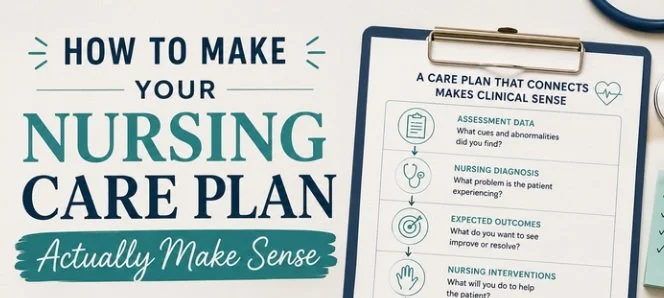
The assessment data should lead you to a nursing problem. The nursing problem should determine what you want to improve. Your interventions should address that problem. Your rationale should explain why those interventions matter. And your evaluation should tell you whether your patient actually improved.
When those pieces connect, the care plan starts to make a lot more sense.
Start With Why Your Patient Is Here
The admitting diagnosis gives you an important starting point. It tells you what condition, injury, or event brought your patient to the hospital and gives you some idea of what you might expect to find.
But it does not tell you everything you need to know about the patient in front of you.
Two patients can both be admitted with pneumonia and have very different assessment findings, risks, and nursing priorities. That is why the admitting diagnosis should give you direction, while your assessment determines what is actually happening with your patient.
Before you start filling in the rest of your care plan, make sure you understand:
· Why is this patient here?
· What would I expect with this condition?
· What complications should I be watching for?
· What assessments are going to matter most?
That gives you the clinical context you need for everything that comes next.
Your Assessment Data Is the Evidence
This is where students can get into trouble with care plans. It is tempting to collect everything. Every vital sign. Every lab. Every medication. Every assessment finding. Every piece of information in the chart.
But the goal isn't to prove that you collected a lot of data. The goal is to identify the data that tells you what is happening with your patient.
As you review your assessment, start asking:
· What did I expect to find?
· What is abnormal?
· What has changed from baseline?
· What requires closer monitoring?
Your assessment data should provide the evidence for the rest of your care plan. The nursing diagnosis, expected outcomes, interventions, and evaluation should all connect back to what you identified here.
If you cannot connect a piece of information to your patient's care, ask yourself whether it really needs to be part of the plan.
Now Ask: What Is the Nursing Problem?
Once you understand what is happening with your patient, you can determine the nursing problem that deserves your attention. This is where it is important to separate the medical diagnosis from the nursing diagnosis.
The medical diagnosis identifies the disease or condition.
The nursing diagnosis identifies the patient's response to that condition and helps determine the nursing care the patient needs.
So instead of jumping straight from: Pneumonia → Impaired Gas Exchange
slow down and ask: What is actually happening with THIS patient?
Maybe your patient with pneumonia has an oxygen saturation of 89%, tachypnea, crackles, and shortness of breath.Now you have evidence supporting the nursing problem. And that is an important distinction.
You should not choose the nursing diagnosis because it commonly goes with the medical diagnosis. You should choose it because your patient's assessment supports it.
Decide What You Want to Change
Once you identify the problem, the next question becomes: What should improve if my nursing care is effective?
That is your expected outcome.
A good expected outcome isn't simply another box to complete. It gives the rest of your care plan a target. If your patient's problem is impaired gas exchange, what would improvement actually look like?
Maybe you expect the patient's oxygen saturation to remain at or above a specific level during the shift. If the problem is deficient fluid volume, perhaps you expect the patient to maintain adequate urine output. The important part is that the outcome is patient-centered, specific, measurable, realistic, and time-limited.
Think of it this way: If I come back later and reassess this patient, what would I need to see to know my plan is working?
If you cannot answer that question, your expected outcome probably needs to be more specific.
Choose Interventions That Actually Address the Problem
Now you can decide what the nurse needs to do. Instead of searching for a generic list of nursing interventions for a diagnosis, go back to your patient.
Ask:
· What should I assess or monitor?
· What can I do to improve this patient's condition?
· What complication am I trying to prevent?
· What treatment or medication is needed?
· Which actions are most important for patient safety?
Your interventions should connect directly to the nursing diagnosis and the outcome you are trying to achieve.
This is also where prioritization matters. Not every intervention is equally important. If your patient has an immediate airway, breathing, perfusion, neurological, infection, or safety concern, that threat may need to be addressed before other parts of the plan.
A care plan should reflect what your patient actually needs, not simply provide enough interventions to meet the assignment requirements.
Your Rationale Should Answer “Why?”
A rationale should not just restate the intervention. Id should explain why you are doing a specific intervention and how it will help the patient.
A strong rationale connects the nursing action to the patient's physiology, condition, safety needs, or expected outcome. In other words, it explains why the intervention matters.
If you can explain the why behind your intervention, you are doing more than completing a care plan. You are practicing clinical reasoning.
Evaluation Is More Than Writing “Goal Met”
You are not finished when you complete the interventions. You have to go back to the patient and find out if your interventions made an impact on the patient.
Return to the expected outcome you created earlier and compare it with your patient's current assessment.
· Did the patient meet the expected outcome?
· What improved?
· What stayed the same?
· Did anything get worse?
· How did the patient respond to your interventions?
· Does the plan need to continue, or does something need to change?
Evaluation is where you determine whether the care you provided actually moved the patient toward the outcome you wanted. If the patient did not improve, that tells you something too. You may need to reassess, identify new cues, reconsider the problem, or modify the plan.Patient care doesn't stop just because you reached the last box on the worksheet.
Think of the Care Plan as a Cycle, Not a Checklist
This may be the biggest shift you can make in how you approach care plans.
Instead of thinking:
Assessment → Diagnosis → Outcome → Intervention → Rationale → Evaluation → DONE
think:
Assess → Identify the problem → Plan → Intervene → Evaluate → Reassess
Then repeat the process based on what your patient does next.
Your patient's response determines whether you continue the plan, modify it, or recognize that a new problem is developing. That is much closer to what nurses actually do. And suddenly, the boxes aren't separate anymore.
They are telling one connected story:
What is happening with my patient?
↓
What is the priority problem?
↓
What do I want to improve?
↓
What can I do about it?
↓
Why will those actions help?
↓
Did my patient improve?
↓
What needs to happen next?
That is the purpose of the care plan.
It isn't just about completing an assignment.
It is about learning how to think through patient care.
Need Help Putting It All Together?
If you're working on nursing care plans and still feel like you're filling in boxes instead of understanding how everything connects, I created a resource to help.
Download the FREE Clinical Judgment Care Plan Guide
The Clinical Judgment Care Plan Guide walks you through the care planning process step by step and helps you connect your assessment findings, nursing diagnosis, expected outcomes, interventions, rationales, evaluation, patient education, collaboration, and ongoing plan.
The guide was specifically designed to help nursing students move beyond simply completing care-plan boxes and understand how each part connects to the patient's clinical picture.
14-page PDF • Completely free
No email signup. No account. Just download it and use it.