Doing More Questions Isn’t the Same as Learning From Them
You read the PowerPoint. You review your notes. You make flashcards. Maybe you create a study guide, use a question bank, or upload your course material to a study tool and generate practice questions.
You take a quiz. You get most of the questions right. Then you sit down for the exam and think:
Why do these questions feel so much harder?
It may not be because you didn't study enough.
It may be because the way you practiced and the way you're being asked to use the information are two different things.
First: You Still Have to Learn the Content
Let's get one thing out of the way. Memorization is not the enemy. There are things in nursing school that you simply need to know.
You need to know what medications do. You need to know important adverse effects. You need to understand disease processes, expected assessment findings, laboratory values, interventions, and safety considerations.
You can't recognize hypokalemia in a patient if you don't know what potassium is. You can't decide whether a medication is safe to give if you don't know what the medication does. And you can't recognize that a patient is getting worse if you don't know what you expected to see in the first place.
Learning the content is step one. It's just not the last step.
Knowing the Information Can Feel a Lot Like Being Ready to Use It
This is where nursing school gets tricky. You've been studying hypokalemia. Then you get this question:
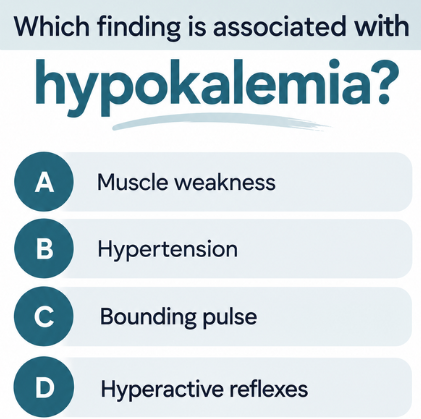
You remember: Hypokalemia causes muscle weakness. You choose A. You get it correct.
That question served a purpose. It checked whether you knew an important piece of information. But look at what the question also did for you.
It told you exactly what to think about: Hypokalemia.
Now compare it with this:
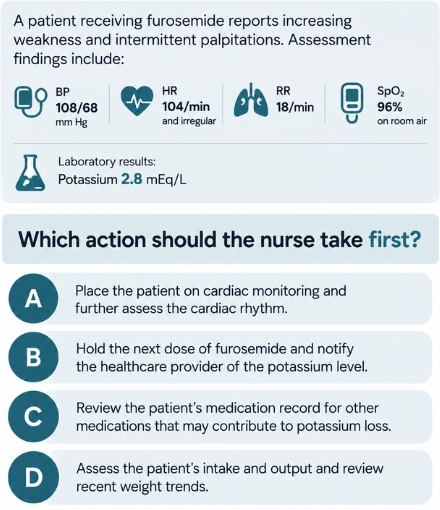
The nursing content hasn't suddenly changed. What you're being asked to do with it has.
No one told you this was a hypokalemia question. You had to recognize it from the information in front of you.
The furosemide matters. The potassium of 2.8 matters. The weakness and palpitations matter. The irregular heart rate matters. More importantly, you have to recognize that those findings belong together.
Then you have to decide what they mean for the patient right now.
That requires more than remembering that muscle weakness can occur with hypokalemia. You have to recognize the problem, connect the findings, determine what is most concerning, and choose the action that addresses the immediate risk.
Same content. But now you have to use it.
What are you actually practicing while you study?
Think about what most of your study time asks you to do.
If you're mostly: Recognizing → Remembering → Repeating
But the questions you're struggling with require you to: Notice → Connect → Prioritize → Decide → Respond
There's a mismatch.
You may know the information. But knowing that potassium below 3.5 mEq/L is low is different from recognizing that a patient taking furosemide who develops weakness, palpitations, and an irregular heart rate may be showing you a problem related to potassium loss.
One asks you to remember what you learned. The other asks you to use it.
Your Study Tool Can Help. But It Needs Better Instructions
This is especially important if you're using a tool that lets you upload your PowerPoints, lecture slides, notes, or other course materials.
You might already be using it to make flashcards, create study guides, summarize information, or generate practice questions. And that's useful. But think about what happens when your entire instruction is:
“Make me 30 practice questions from this PowerPoint.”
The tool knows you want questions. It doesn't know what you want those questions to make you do.
It doesn't automatically know that you want to practice connecting clues, figuring out what matters, making nursing decisions, or responding when the patient's condition changes.
You have to tell it. And that's where a small change in how you use these tools can make a big difference.
Instead of Asking for More Questions, Change What the Questions Ask You to Do
Once you know the basic information, the next step isn't necessarily to generate more questions. It's to change what those questions require you to do. Think about the parts of nursing questions that actually give you trouble.
Maybe you struggle when the topic isn't obvious. Maybe you know individual facts but don't recognize when several patient findings are connected. Maybe you can identify what's abnormal but have trouble deciding what matters most.
Maybe you consistently narrow the answer choices down to two reasonable nursing actions. Maybe you recognize a concerning finding but aren't sure whether you should assess further or act. Or maybe you can choose an intervention but don't always think about what you should expect to happen afterward.
These aren't all the same problem. So why would you practice them all the same way?
There are ways to use the nursing material you're already studying to practice each of these skills. You can make your practice require you to:
Notice → Connect → Prioritize → Decide → Reassess
You can practice recognizing information without being told what topic to think about. You can practice sorting through several patient findings instead of being handed one obvious clue.
You can practice choosing between competing priorities. You can practice recognizing changes over time. You can even practice what happens after you've made your first decision.
The content doesn't have to change. What you're practicing DOING with the content does.
The Goal Isn't to Stop Using Flashcards, Study Guides, or Basic Questions You still need them. You need to learn medications, laboratory values, disease processes, assessment findings, interventions, and the other content your course expects you to know.
The point isn't: Stop memorizing.
It's: DON'T STOP AT MEMORIZING.
Once you know the information, start pushing yourself further:
Can I recognize it?
Can I connect it?
Can I decide what matters?
Can I determine what should happen first?
Can I recognize when something changes?
Can I determine whether an intervention worked?
That's the shift. You aren't necessarily studying more. You're practicing doing more with what you studied.
Want Help Turning Your Course Material Into This Kind of Practice?
That's exactly what I created How to Actually Study for Nursing School to help you do.
It's not a question bank.
It's a 27-page digital guide that shows you different ways to practice using the nursing content you're already learning and gives you ready-to-use copy + paste prompts to help you do it. The prompts are designed to create practice involving patient situations, changing patient data, prioritization, assessment, medications, labs, connecting information, and nursing decision-making.
Instead of opening your study tool and simply typing: “Make me practice questions.”
you'll be able to think: WHAT DO I WANT TO PRACTICE DOING?
Then choose the prompt that helps you practice it.
Because sometimes you don't need another 50 questions.
YOU NEED BETTER PRACTICE.
→ Visit the Clinical Judgment Lab Etsy Shop