Clinical Judgment in Action: A Step-by-Step Case Study
Follow John’s case as it unfolds from the first assessment through evaluation. At each step, decide what matters and what should happen next, then reveal the clinical reasoning behind the decision.
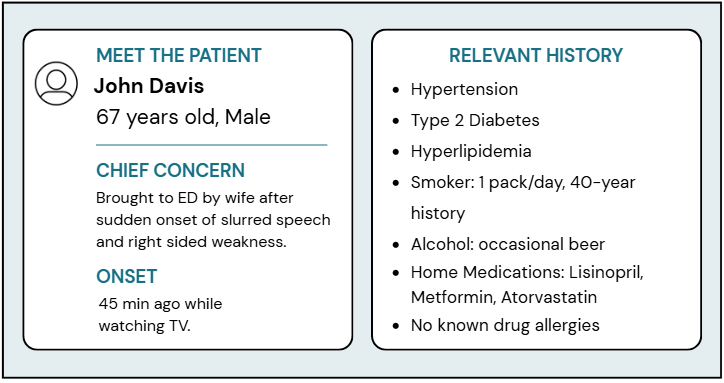

John’s wife reports that they were watching television when she suddenly noticed that his speech sounded strange. When he attempted to stand, his right leg appeared weak. She states his symptoms began approximately 45 minutes ago.
Recognize The Cues: What Information Matters Right Now?
As you read through the scenario, what findings stand out as abnormal, new, changing, or concerning? These assessment findings are the clues that will help you determine what is happening to the patient. You don’t have to figure out exactly what is happening yet, you just need to identify what isn’t normal. At this step you’re simply asking
“What am I noticing, and what information matters?”
-
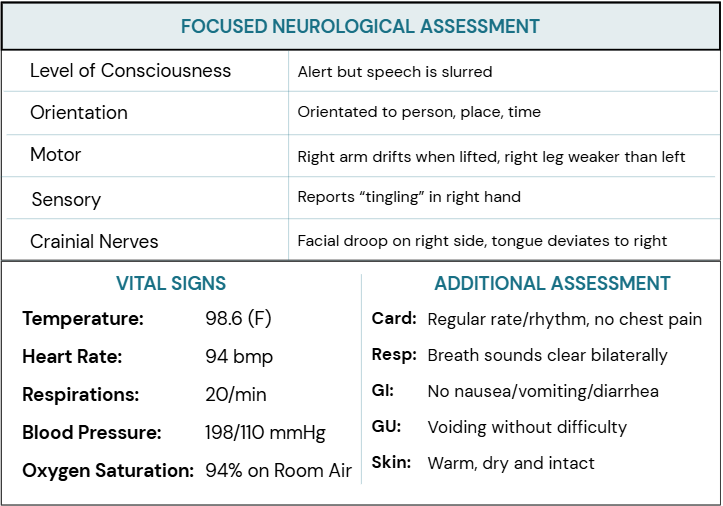
Several findings should immediately stand out in John’s initial assessment:
Sudden onset of symptoms
John’s symptoms began suddenly approximately 45 minutes ago. The timing matters because this is a new, acute change from his baseline.Slurred speech
John has a new change in his ability to speak clearly. Any sudden change in speech is an important neurological cue.Right-sided facial droop
Facial asymmetry is an abnormal neurological finding, especially when it appears suddenly.Right arm drift and right leg weakness
John has decreased motor function on one side of his body. The fact that the weakness is unilateral makes this an especially important finding.Tingling in the right hand
This represents a new sensory change on the same side as his motor weakness and adds another abnormal neurological finding to the assessment.Tongue deviation to the right
This is another abnormal finding involving neurological function and should not be overlooked.Blood pressure of 198/110 mmHg
John's blood pressure is significantly elevated. Although he has a history of hypertension, you should not assume that this blood pressure is normal for him. It is an important finding in the context of his acute neurological changes.What about the other information?
Not every piece of information in the scenario carries the same weight.
John's temperature is normal, his heart rate and respiratory rate are not markedly abnormal, he is currently alert and oriented, and he reports no chest pain, nausea, or vomiting. These findings still contribute to the overall assessment, but they do not stand out in the same way as his sudden neurological changes and significantly elevated blood pressure.
His history also provides important context. Hypertension, type 2 diabetes, hyperlipidemia, and a long history of smoking are relevant pieces of information. At the Recognize Cues step, however, your job is not yet to decide exactly how those factors relate to John's current condition.
THE BIG IDEA
Notice what we haven't done yet: we haven't diagnosed John.
We simply pulled the most meaningful information out of a much larger patient scenario.
Instead of treating every finding as equally important, we recognized a group of new and concerning cues:
Sudden symptom onset + slurred speech + facial droop + unilateral weakness + sensory changes + markedly elevated blood pressure
These are the findings that should move forward with us into the next step, where we'll begin asking:
What do these cues mean when we consider them together?
Analyze The Cues: What do these findings mean together?
Analyze Cues means taking the important information you noticed and starting to make sense of it.
Instead of looking at each finding by itself, look for connections, patterns, and relationships. Ask yourself whether several findings could be pointing toward the same problem.
Based on the cues you recognized in John’s assessment, what could they be telling you about his condition? Think about how the timing, location, and combination of John's symptoms fit together.
You’re not deciding what to do yet. At this step, you’re trying to understand what the patient’s findings may be telling you.
Ask yourself: “How do these findings connect, and what could they mean together?”
-
John’s findings are not random or unrelated. His symptoms began suddenly, and several of them involve neurological function on the same side of the body.
He has:
Slurred speech
Right-sided facial droop
Right arm drift
Right leg weakness
Tingling in the right hand
Tongue deviation to the right
When these findings are considered together, they create a pattern of sudden focal neurological dysfunction. That pattern matters.
A single finding by itself may have several possible explanations. Weakness alone could be caused by many different problems. Slurred speech alone could also have more than one cause. But when sudden speech changes, facial asymmetry, unilateral weakness, and unilateral sensory changes occur together, an acute cerebrovascular event becomes a major concern.
John’s history strengthens that concern. He has hypertension, type 2 diabetes, hyperlipidemia, and a long history of smoking, all of which increase his risk for vascular disease and stroke.
His blood pressure of 198/110 mmHg is also important. At this point, the elevated blood pressure does not tell you the exact cause of his symptoms, but it is a significant part of the clinical picture and may affect later treatment decisions.
The timing of the symptoms is especially important. John was last known well approximately 45 minutes ago, which means this is an acute change and that time-sensitive treatment may still be possible depending on what additional testing shows.
What can we conclude right now?
John’s assessment findings are highly concerning for an acute stroke, most likely an acute cerebrovascular event.
But analyzing the cues does not mean we know everything yet.
The current assessment cannot tell us whether John is experiencing an ischemic stroke, a hemorrhagic stroke, or another condition that could mimic stroke symptoms. More information is still needed before treatment decisions can safely be made.
THE BIG IDEA
Analyzing cues means moving beyond: “What findings are abnormal?”
and asking: “How do these findings fit together, and what pattern are they creating?”
For John, the pattern is:
Sudden onset + speech changes + facial droop + unilateral weakness + unilateral sensory changes
Together, these cues point toward an acute neurological event and make stroke the leading concern.
The next question becomes: What must we determine or rule out before we decide what happens next?
Prioritize Hypothesis: What is the Greatest Concern Right Now?
Prioritize Hypotheses means taking the possible problems you identified and deciding which problem is most likely, most urgent, or poses the greatest risk to the patient.
You’ve identified the important cues and considered how they fit together. Now it’s time to decide which possible explanation should move to the top of your list.
Not every possible explanation carries the same likelihood or urgency. Consider the pattern of John’s findings, how quickly his symptoms developed, and what could happen if the most serious possibilities are not recognized quickly.
You’re not choosing an intervention yet. At this step, you’re deciding what problem should become your priority.
Ask yourself: “What am I most concerned could be happening to this patient right now?”
-
John’s findings make an acute stroke the leading hypothesis.
His symptoms began suddenly and include slurred speech, facial droop, unilateral weakness, and sensory changes. When considered together, these findings create a pattern of acute focal neurological dysfunction.
John also has several factors that increase his risk for cerebrovascular disease, including hypertension, type 2 diabetes, hyperlipidemia, and a long history of smoking.
But identifying stroke as the leading hypothesis does not mean the reasoning stops there.
The team still does not know what type of stroke John may be experiencing.
An ischemic stroke occurs when blood flow to an area of the brain is interrupted, while a hemorrhagic stroke occurs when bleeding develops in or around the brain. Both can cause sudden neurological deficits, and John's assessment findings alone cannot reliably distinguish between them.
The nurse should also consider conditions that can produce stroke-like symptoms. For example, hypoglycemia can cause acute neurological changes and needs to be quickly ruled out.
This is why prioritizing hypotheses is more than simply naming a diagnosis. You are ranking the possibilities based on the patient's presentation while recognizing what you know and what you still don't know.
For John:
Most likely: An acute stroke
Still need to distinguish: Ischemic vs. hemorrhagic
Also need to consider: Conditions that can mimic stroke
The next step is to gather the information needed to narrow those possibilities.
THE CLINICAL JUDGMENT CONNECTION
At this point, you should be thinking: “I have a strong idea of what may be happening, but what information do I need before I can act on it?”

GENERATE SOLUTIONS: What Could Help This Patient?
Generate Solutions means thinking through the possible actions that could help address the patient’s priority problem.
You’ve identified what you’re most concerned about. Now you begin asking, “What could the nurse do next?”
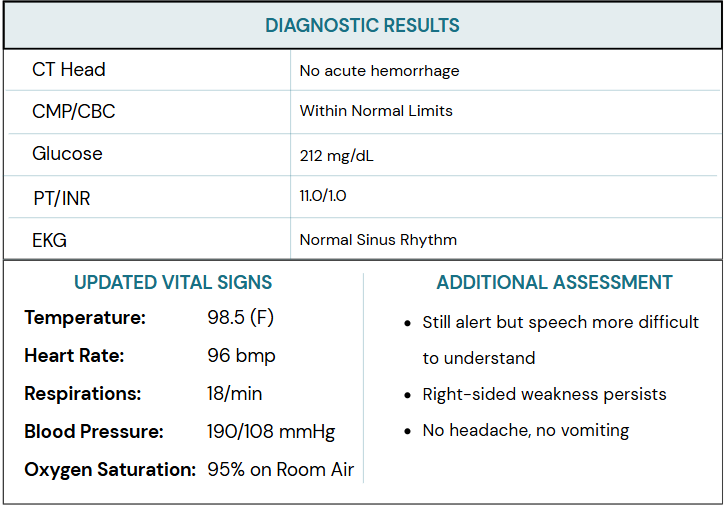
You now have additional information about John. His CT scan, lab work, and EKG.
At this step, think about the possible interventions, treatments, and next steps that could address the priority problem you identified.
Consider what needs to happen quickly, what additional information may still be needed, and what could affect which interventions are appropriate.
The goal is to come up with actions that match what is happening with the patient and could improve the situation or prevent it from getting worse.
Based on what you know about John now:
What interventions or treatments should the healthcare team consider?
What needs to happen before those interventions can safely be initiated?
What findings could affect the plan?
-
The new information helps narrow the possibilities.
John continues to have sudden focal neurological deficits, but his CT shows no acute intracranial hemorrhage. His blood glucose is 212 mg/dL, making hypoglycemia an unlikely explanation for his neurological symptoms. His coagulation studies are also within expected limits.
The concern for an acute ischemic stroke is now stronger.
Because John's symptoms began approximately 45 minutes before arriving in the emergency department, the team should rapidly determine whether he is eligible for IV thrombolytic therapy.
But identifying a possible treatment does not mean the nurse immediately administers it.
The team still needs to determine whether John meets the criteria for treatment and whether anything would make thrombolytic therapy unsafe. This includes confirming his last-known-well time, reviewing his medical and medication history for contraindications, evaluating relevant laboratory and imaging results, and continuing to assess his neurological status.
John's blood pressure is also an important part of the plan.
His current blood pressure is 190/108 mmHg. For a patient who is otherwise eligible for IV thrombolytic therapy, blood pressure must be reduced to below 185/110 mmHg before treatment is initiated. This means blood pressure management may need to occur before thrombolytic therapy can safely begin.
At the same time, stroke care is time-sensitive. The nurse should anticipate rapid coordination with the stroke team or provider, frequent neurological reassessment, continued monitoring of vital signs, IV access, and preparation for ordered treatment.
PUT THE OPTIONS TOGETHER
Appropriate solutions may include:
Activate or continue the facility's acute stroke protocol.
Determine eligibility for IV thrombolytic therapy.
Address the elevated blood pressure according to prescribed stroke protocol.
Continue frequent neurological and vital-sign assessments.
Maintain IV access and prepare for time-sensitive medications or interventions.
Keep the patient NPO until swallowing safety has been evaluated.
Continue monitoring for neurological deterioration.
Communicate changes in John's condition immediately.
THE CLINICAL JUDGMENT CONNECTION
Generate Solutions is where you ask: “Given what I know now, what could we do about it?”
You are identifying appropriate options, not yet choosing and carrying out every action.
For John, several solutions are possible, but they depend on his continued assessment and treatment eligibility.
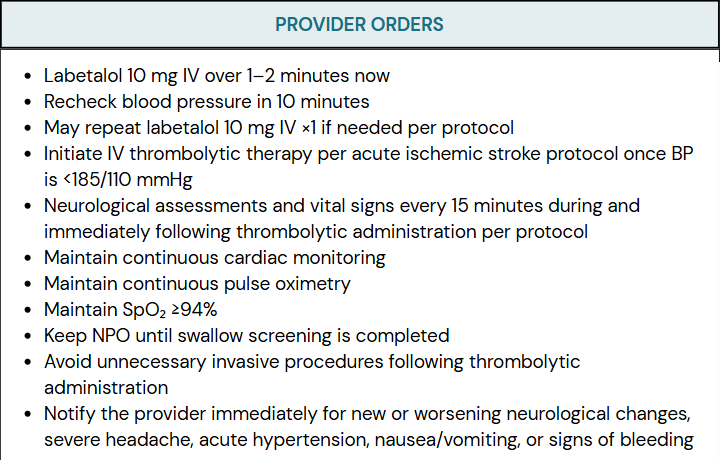
The stroke team determines that John is a candidate for IV thrombolytic therapy if his blood pressure can be reduced to the required range.
The provider enters the following orders:
Take Action: What Should You Do Now?
You have identified possible solutions, reviewed the new diagnostic information, and received the provider’s orders.
Now it is time to decide which actions should be carried out first and in what order.
Look carefully at John’s current assessment findings, vital signs, and the orders you have received. Some actions may need to happen before others can safely move forward.
What should the nurse do first?
Which actions can happen at the same time?
What should the nurse reassess before moving forward with the treatment plan?
What findings would require the nurse to stop and notify the provider?
-
John has been identified as a candidate for IV thrombolytic therapy, but the nurse still needs to look at the patient in front of them before carrying out the orders.
John’s blood pressure is currently 190/108 mmHg.
That matters because blood pressure must be below 185/110 mmHg before IV thrombolytic therapy is initiated.
So although thrombolytic therapy is part of the treatment plan, it is not the first medication the nurse should administer.
START WITH THE BLOOD PRESSURE
The nurse should administer the prescribed labetalol 10 mg IV over 1–2 minutes. After administering the medication, the nurse should reassess John’s blood pressure as ordered.
This reassessment is important. The nurse should not assume that giving the medication means the problem has been corrected. The next action depends on how John responds.
If John's blood pressure decreases to the required range and he continues to meet treatment criteria, the team can move forward with the ordered IV thrombolytic therapy.
If his blood pressure remains above the required threshold, the nurse should follow the additional blood pressure management orders and protocol rather than proceeding with thrombolytic administration.
OTHER ACTIONS ARE HAPPENING TOO
While addressing John’s blood pressure, the nurse should continue the other components of his acute stroke care.
This includes:
Continuing frequent neurological assessments
Monitoring vital signs closely
Maintaining continuous cardiac monitoring and pulse oximetry
Maintaining IV access
Keeping John NPO until swallowing safety has been evaluated
Watching closely for any change in neurological status
The nurse is not completing these actions as unrelated tasks. Each one helps determine whether John remains stable and whether the treatment plan can safely continue.
THEN MOVE FORWARD
Once John's blood pressure is within the required range and his eligibility has been confirmed, the nurse can proceed with the ordered IV thrombolytic therapy according to the acute stroke protocol.
Close monitoring becomes especially important during and after treatment. The nurse should watch for findings that could indicate a complication, including:
New or worsening neurological deficits
Decreased level of consciousness
Sudden severe headache
Nausea or vomiting
Acute changes in blood pressure
Signs of bleeding
Any significant change requires immediate reassessment and communication with the healthcare team.
SEE THE SEQUENCE
The important part isn't simply knowing that John needs treatment.
It is recognizing what has to happen first and what information tells you whether it is safe to move to the next action.
For John, the sequence is:
Administer the ordered antihypertensive → reassess the blood pressure → determine whether treatment parameters are met → proceed with the ordered thrombolytic therapy if appropriate → continue close monitoring.
THE CLINICAL JUDGMENT CONNECTION
Take Action asks: “Based on what I know right now, what should I actually do?”
You generated possible solutions in the previous step.
Now you are putting the plan into action, prioritizing the sequence, and continuing to reassess the patient as you go.
And that leads to the final step: How will you know whether the interventions worked?

Evaluate Outcomes: Did the Plan Work?
Taking action is not the end of clinical judgment. Now you need to compare John’s current condition with where he started and determine how he responded to the interventions.
Look for improvement, worsening, or new findings. Then decide whether the current plan should continue or whether something needs to change.
Based on John’s latest assessment:
Which findings suggest the interventions are having the desired effect?
Which findings still require continued monitoring?
What findings would tell you that John is getting worse or developing a complication?
Would you continue the current plan or does something need to change?
-
Evaluation begins by comparing where John is now with where he was before the interventions were started.
One of the first goals was to lower John's blood pressure enough for thrombolytic therapy to be administered safely.
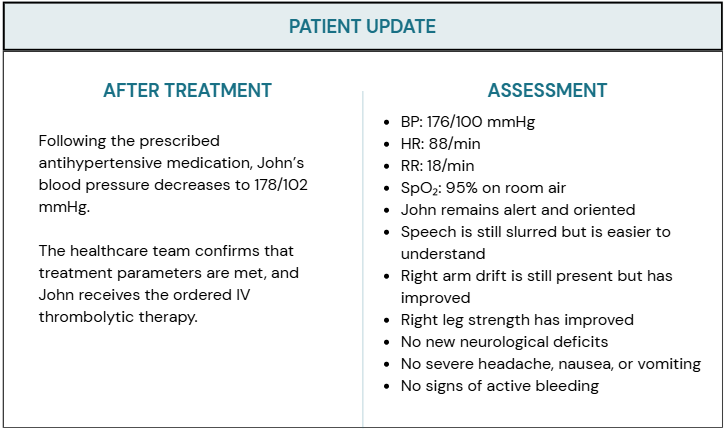
His blood pressure decreased from 190/108 mmHg to 178/102 mmHg, allowing the treatment plan to move forward. Following treatment, his blood pressure remains below the post-thrombolytic target of 180/105 mmHg.
Now look at his neurological status.
John still has some neurological deficits, but his speech is easier to understand, his right arm weakness has improved, and his right leg strength has improved. He remains alert and oriented and has developed no new neurological deficits.
These findings suggest neurological improvement rather than continued deterioration. But improvement does not mean the nurse stops monitoring.
John has received thrombolytic therapy, so the nurse must continue to watch closely for complications, particularly bleeding and neurological deterioration.
A sudden severe headache, vomiting, decreased level of consciousness, new or worsening neurological deficits, acute hypertension, or other evidence of bleeding would be concerning and require immediate action.
LOOK AT THE WHOLE PICTURE
Evaluation isn't simply asking: “Is the patient better?”
It means asking:
· “Did the patient respond the way I expected?”
· “Are the interventions achieving the intended outcome?”
· “Has anything new or concerning appeared?”
· “Should the current plan continue, or does it need to change?”
For John, the current findings suggest that the treatment plan is having the desired effect. His neurological function is beginning to improve, his blood pressure is within the required range, and there are currently no obvious signs of a serious treatment complication.
The appropriate response is to continue the prescribed monitoring and stroke care while repeatedly reassessing his neurological status, vital signs, and signs of bleeding.
THE CLINICAL JUDGMENT CONNECTION
Evaluate Outcomes completes the six steps, but it does not mean clinical judgment is finished.
If John's condition changes, the nurse begins the process again:
What am I noticing now?
What does it mean?
What is the priority?
What should I do next?
That is what makes clinical judgment a continuous process rather than a one-time checklist.
CLINICAL JUDGMENT DOESN'T HAPPEN IN SIX PERFECT STEPS
The Clinical Judgment Measurement Model gives you a framework for organizing your thinking, but real patient care doesn't always move neatly from Step 1 to Step 6.
New information appears.
Lab results come back.
Vital signs change.
The patient responds, or doesn't respond, to an intervention.
And each time something changes, you may need to go back and ask:
What am I noticing now?
What does it mean?
What matters most?
What should happen next?
The goal isn't just to memorize the six steps.
It's to practice thinking through patient situations until this way of reasoning starts to become more natural.
KEEP PRACTICING WITH CLINICAL JUDGMENT LAB
Clinical Judgment Lab gives you more opportunities to practice recognizing important findings, connecting patient data, setting priorities, choosing nursing actions, and evaluating what happens next.
Through short patient scenarios, step-by-step clinical reasoning, and practical nursing examples, you can practice the thinking that happens between knowing the content and choosing what to do with it.
Know the content. Then practice using it.
EXPLORE CLINICAL JUDGMENT LAB
Practice more patient scenarios, explore Clinical Judgment Minutes, and find resources designed to help you strengthen your clinical reasoning one decision at a time.